


Get The AI Search Optimization Checklist Worksheet
Updated on September 26, 2026
If you want to successfully improve your AI search visibility in a consistent, durable and impactful way, you need to establish an aligned process and criteria taking into account your marketing and business goals. This AI search optimization checklist provides this workflow by answering key questions:
- Which AI search journeys are actually commercially or strategically important to influence?
- Where’s the brand shown, recommended, linked, winning comparisons, or described inaccurately?
- Which owned pages, earned sources and shared web presence are influencing those outcomes?
- Which technical, content and/or promotional gap is the most plausible explanation for each pattern?
- Which technical, content and/or marketing actions are most likely to improve it, and who owns it?
- How will we measure progress and impact while differentiating AI platforms, page roles or confidence levels?
The focus of this AI Search optimization checklist is to cover important journeys, show and give your business the information needed, and provide the arguments and supporting evidence for your business in an accessible and understandable way to take action.
It’s also important to note that when optimizing for AI platforms it’s recommended to avoid doing it so while exploiting AI systems’ current weaknesses: Prompt injection, fabricated reviews, manufactured community signals and citation gaming might end up producing short-term improvements, but they will get eventually addressed, and will trade durable trust for visibility that can backfire.
Now, let’s go through it.
The AI Search Optimization Checklist at a Glance
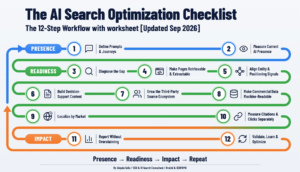
The AI search optimization checklist runs on top of my 3 Layer Framework to Measure AI Search Presence, Readiness and Business Impact, rather than along with it:
- Steps 1 to 2 measure AI search presence
- Steps 3 to 10 diagnose and fix readiness, owned content, extractability, entities, third-party corroboration, commercial data and localization.
- Steps 11 to 12 report AI business impact and validate whether the expected outcome is achieved
Each step hands a hypothesis to the next. Let’s go through the checklist featuring for each step, the key questions to answer, actions to take, mistakes to avoid, the goal to achieve and recommended guides for each. To facilitate execution, you can also get and copy a Google Sheets version for the checklist here:
| Step | Step Description | Layer | Key question to answer | Key actions to take | Target Outcome / Goal | Recommended guide for execution |
|---|---|---|---|---|---|---|
| 1 | Establish the prompts and journeys you actually want to influence in AI systems | Presence | Are we measuring representative, commercially relevant decisions across the customer journey? | Define the business scope, audiences, journey stages, buyer constraints, products, markets, languages, competitors and priority platforms. Build the coverage matrix before writing prompts. Start with 30-50 tagged core prompts and keep experimental prompts separate. | Prompt library coverage across priority products, audiences, journeys and markets; share of P1 journey cells represented | How to Build a Representative AI Search Prompt Library for Better AI Visibility Measurement |
| 2 | Measure your initial AI presence in popular AI systems before implementation | Presence | Do we appear, get recommended, receive a link, win comparisons and get described accurately in meaningful prompt groups across popular AI systems? | Run each core prompt three to five times within a fixed 24-72 hour window. Document platform, market, location, language, account state and model or experience. Record appearance, recommendation, link, comparative preference, accuracy, sources and competitors. | Prompt coverage; recommendation rate; linked citation rate; comparative win rate; representation accuracy | A 3 Layer Framework to Measure AI Search Presence, Readiness and Business Impact |
| 3 | Diagnose your brand AI search presence gap before taking action | Readiness | Which readiness / optimization characteristic or condition best explains the observed AI presence pattern across platforms? | Map every meaningful AI search presence pattern to one primary readiness or source hypothesis: accessible, extractable, useful, fresh, differentiated, recognizable, consistent, corroborated, credible or transactable. Record the evidence, affected segment, owner and expected KPI. Prioritize with Severity x Importance / Effort. | Priority gap score; number of meaningful AI presence gaps with an evidence backed hypothesis, owner and validation plan | The 10 Key Characteristics of AI Search Winning Brands |
| 4 | Make priority pages retrievable and extractable for AI systems | Readiness | Can search and AI systems reach, render and isolate the information needed for target prompts and topics? | Audit priority URLs for crawlability, indexability, rendering, internal linking, etc. for key AI systems. Feature critical facts, content and links in raw HTML. Use descriptive headings, direct answers, named entities, explicit criteria and self-contained tables. Validate after implementation. | Fetch/render success; extractability checks passed; linked citation or owned source selection for the affected prompt group | The 10 Key Characteristics of AI Search Winning Brands |
| 5 | Align your brand entity, naming and positioning signals | Readiness | Are the brand, products, category, audience, people and markets described explicitly and consistently across the on-page and third-party sources that influence AI answers? | Create a dated, approved fact sheet covering official names, product and category descriptions, audiences, markets, plans, key claims, founders, headquarters and canonical profiles. Compare it with visible copy, structured data, listings, review platforms, partner pages and influential third-party descriptions. Correct stale or conflicting sources and re-assess accuracy. | Representation accuracy; entity confusion frequency; influential profiles or listings corrected | The 10 Key Characteristics of AI Search Winning Brands |
| 6 | Create decision support content and prioritize what still has a role after the AI answer | Readiness | What unresolved need gives the user, publisher or AI system a reason to visit, cite or associate this content with the brand? | Audit relevant pages by target prompt and page role. Score click resilience, citation potential, brand mention potential, business value, proprietary advantage and expected effort directionally. Optimize or create comparisons, alternatives, pricing, specifications, documentation, support, research, calculators and other decision support assets. Connect evidence pages to the appropriate next action. | Citation coverage and linked citations for target prompts; qualified visits or conversions from decision support pages; priority content actions completed | Content Prioritization in an AI Search Era |
| 7 | Grow your brand’s third-party AI source ecosystem | Readiness | Which external sources repeatedly validate, compare, demonstrate or challenge the brand for priority prompt groups, and which actions have durable audience and business value? | Map cited domains and source types separately by platform, vertical and market. Classify owned, earned and shared roles; keep paid influence labelled as unobservable where sponsorship cannot be established. Score citation influence, brand association, marketing alignment, business value, strategic durability and effort. Correct inaccuracies and assign actions across PR, reviews, community, creators, partnerships and reputation. | Source coverage and citation share by source type and platform; brand-association accuracy; priority influential sources improved | Third-Party Citation Optimization Prioritization in an AI Search Era |
| 8 | Make commercial and transactional information machine-readable | Readiness | Can users and AI systems understand your products’ offer, constraints, current state and next action without guessing? | Validate product names, categories, prices, currency, stock, variants, plans, features, limits, eligibility, locations, policies and next steps across visible pages, structured data, feeds, merchant programs, marketplaces, partner listings and app stores. Date stamp dynamic data, monitor failures and test discovery, advertising and checkout eligibility separately. | Commercial answer accuracy; feed/schema/listing consistency; price and availability freshness; completion of the intended next customer action | Ecommerce AI Search Optimization: What Citation and AI Traffic Patterns Across 5 Subverticals Tell Us About Going Beyond PDPs and PLPs |
| 9 | Localize your presence by market, not only by language | Readiness | Does the prompt, content, source and competitor system reflect how people ask, trust, compare and act in each targeted country market? | Build separate modules for each priority targeted country market. Assess with local language prompts where relevant, under local and default locations. Localize currency, regulation, availability, competitors, publishers, marketplaces, reviews and trust signals. Validate localized pages, hreflang, internal links, structured data, profiles and market specific third-party sources. | Market level prompt coverage, recommendation and representation accuracy; localized source coverage; local conversions or next actions | Where AI Search Sends Traffic: 10-Market Patterns for Your Global AI Search Strategy |
| 10 | Classify and measure what earns citations and what attracts clicks separately | Readiness | Are we building the evidence AI systems can cite and the destinations users still need to visit, without assuming they’re the same URL? | Classify cited URLs and AI traffic destinations by role and owner: brand entry, discovery/evaluation, action/task, operational and other deep surfaces. Filter authentication, redirect, payment and other operational noise before marketing analysis. Optimize evidence pages and click destinations separately, connect them through clear next action paths, and report citations, referrals and conversions side by side. | Cited page share by role; AI sessions and conversions by destination role; citation to traffic alignment; operational traffic excluded | AI Traffic vs AI Citations: What Clicks and Cited Pages Show About the AI Search Journey |
| 11 | Report AI search optimization efforts and outcomes without overclaiming | Impact | Can the report explain where the brand appears, why it appears that way and whether it creates value, with the right confidence label on each number? | Report AI presence, readiness and business impact as connected but separate layers. Segment by platform, prompt group, market, product, journey and page role. Label measures as observed, own data proxy, third party proxy or modelled. Document denominator, sample, date, conditions and platform limitations. Select leading KPIs that match the business model and report AI referral conversions as a measurable floor. | AI Presence KPIs; readiness hypotheses and action status; AI referral conversions; documented proxy or modelled impact with confidence label | A 3 Layer Framework to Measure AI Search Presence, Readiness and Business Impact |
| 12 | Run a recurring AI validation and optimization loop | Impact | After each implementation, did the expected presence, source, representation or business signal move under comparable conditions? | Rerun your stable core prompt groups under the documented protocol. Log the change, owner, target signal, expected lead time and validation date. Compare platform, market and topic-level patterns, page roles, source movement and business signals. Keep, expand, revise or stop the action based on evidence. Review monthly, quarterly and after key platform, product or market changes. | Change specific target KPI versus baseline after a comparable retest; resulting keep, expand, revise or stop decision | A 3 Layer Framework to Measure AI Search Presence, Readiness and Business Impact |
Resources referenced
- A 3-Layer Framework to Measure AI Presence, Readiness and Business Impact
- How to Build a Representative AI Search Prompt Library
- Content Prioritization in an AI Search Era
- Third-Party Citation Optimization for AI Search
- AI Search Is a Third-Party Citation Problem
- AI Traffic vs AI Citations
- What It Takes for SaaS Brands to Win in AI Search
- Ecommerce AI Search Optimization
- Where AI Search Sends Traffic: 10-Market Patterns
Current platform documentation
These references were verified on 26 September 2026; recheck them before future updates.
- Optimizing your website for generative AI features on Google Search
- From Discovery to Influence: A Guide to GEO
- Google Search Console generative AI performance report for Search
- Google Search Console generative AI performance report for Discover
- Bing AI Visibility Insights: Intents, Topics, Citation Share and Compare
- OpenAI product feeds specification
- Google guidance on Product structured data and Merchant Center feeds
Final takeaway
AI search optimization should start by asking “which AI search journeys do we want to influence, where are we visible or missing, which sources influence the answers, and what do we need to improve to be selected, cited, recommended and accurately represented?”
That is the difference between generic AI content optimization and a defensible AI search process, and it’s why this checklist runs on top of the readiness characteristics and the metric layers rather than alongside them.
Complementary AI search guides
- The 10 Key Characteristics of AI Search Winning Brands
- A 3-Layer Framework to Measure AI Presence, Readiness and Business Impact
- AI Traffic vs AI Citations: What Clicks and Cited Pages Show About the AI Search Journey
- Where AI Search Sends Traffic: 10-Market Patterns for Your Global AI Search Strategy
- AI Search Is a 3rd-Party Citation Problem With an On-Page Corroboration Base: The Data Across SaaS, Ecommerce and Finance
- Content Prioritization in an AI Search Era: A Framework + Worksheet
- Third-Party Citation Optimization Prioritization in an AI Search Era: A Framework + Worksheet


