


Get the The AI Search Winning Brands Assessment Checklist here.
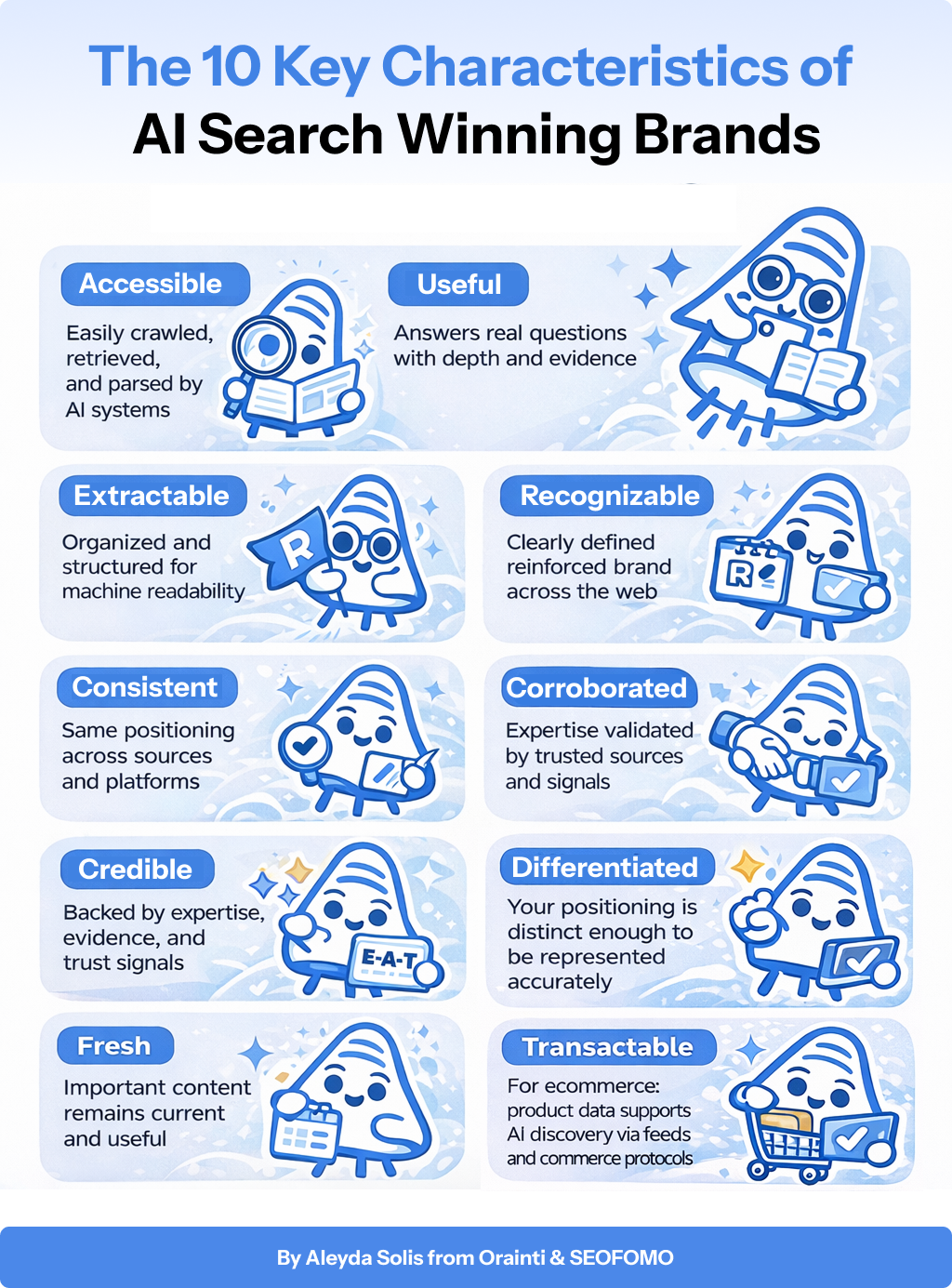
What makes a brand consistently show up and get recommended across AI search platforms? Brands that show up consistently across AI search platforms tend to share a set of practical characteristics.
Some are directly supported by platform documentation, such as crawlability, structured data, and product feeds. Others are strategic inferences based on how retrieval and answer-generation systems work in practice.
The framework below keeps both dimensions separate so the guidance stays useful without overstating certainty.
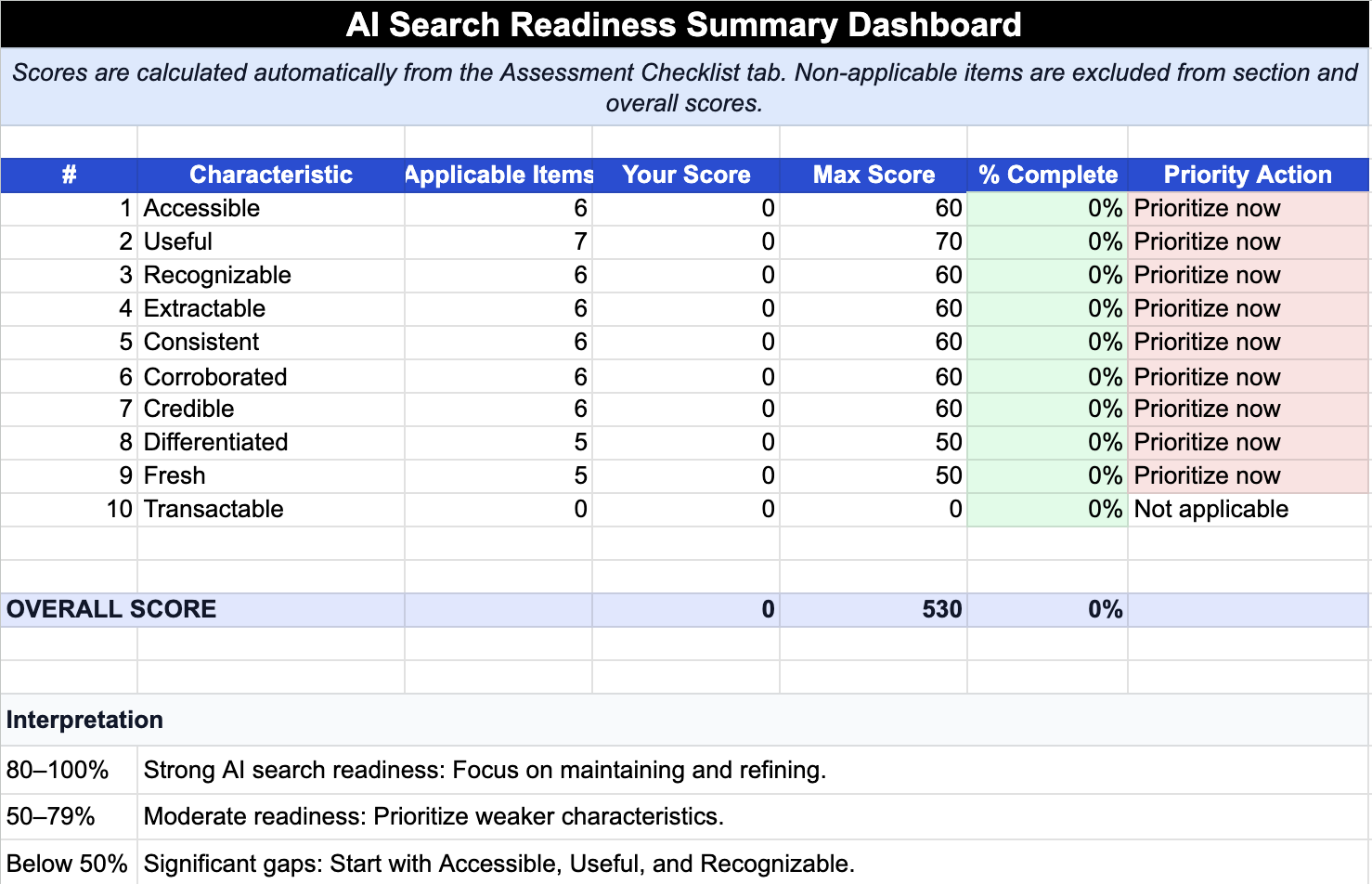
The Assessment Checklist to Use
Use the sheet checklist going through the AI search winning brand characteristics explained below to use for auditing purposes:
The AI Search Winning Brands Assessment Checklist
The AI Search Brand Characteristics Explained
1. Accessible
Goal:
Ensure AI and search systems can crawl, retrieve, render, and understand your content.
AI systems can only cite what they can reach. If your content can’t be crawled, retrieved, and parsed by AI platforms, nothing else matters.
This means ensuring content is accessible to both standard crawlers and AI retrieval systems, supporting server-side rendering for JavaScript-heavy sites, and for ecommerce making product data feeds and APIs machine-queryable. Accessibility is the prerequisite for everything else.
What good looks like:
- Core pages are accessible as crawlable HTML.
- JavaScript does not hide critical content or links.
- Structured data is implemented correctly where relevant.
- Product data is available through structured data, feeds, or both.
Questions to ask:
- Can important pages be crawled without being blocked by robots.txt, authentication walls, or restrictive bot controls?
- Are key pages available as server-rendered or reliably rendered HTML, not only client-side JavaScript?
- Do important internal links exist as standard crawlable links?
- Can search engines and AI crawlers access your core content, not just navigation or template elements?
- For ecommerce, are product feeds available and kept in sync with on-page content?
- Are structured data implementations valid and testable?
Optimize if weak:
- Move critical content out of client-only rendering where possible.
- Audit crawl blocks across search and AI crawlers.
- Validate structured data to ensure validity.
- Add or improve merchant and product feeds where relevant.
How to verify:
- Google Search Console indexing and crawl reports
- Crawlers such as Screaming Frog, Sitebulb or JetOctopus to compare raw HTML vs rendered output
- Reviews of robots.txt, CDN and web server bot directives and configurations
- Log file analysis to confirm crawler access patterns
2. Useful
Goal:
Publish content that genuinely helps users solve a problem or make a decision, while covering your core topics with enough depth to be seen as a reliable source.
AI systems tend to surface content that demonstrates clear utility beyond keyword relevance. Content that gets cited answers real questions with depth, evidence, and expert analysis, not surface-level overviews. Insightful content with citations, statistics, and expert quotes is more likely to achieve visibility in AI-generated responses.
If your content doesn’t add genuine value, it is less likely to be surfaced.
What good looks like:
At the page level, the content is helpful, specific, and better than a generic overview. At the site level, your content forms a coherent, connected system around the areas where you want visibility.
Questions to ask:
- Does this page answer a real user question clearly and completely?
- Does it add original value, not just repeat what others already say?
- Does it include evidence, examples, data, expert input, or first-hand experience?
- Would a user leave feeling they got what they needed?
- Is the content written for people first, rather than only for visibility?
- Does your site cover the topics you want to be known for from multiple angles and levels of depth?
- Are related subtopics and concepts connected through logical internal linking and content architecture?
- Does your content cover the related entities and concepts naturally associated with your topic area?
- Would a system find a coherent body of knowledge on your site, or isolated pages with gaps?
- Are you covering the full customer journey: informational, comparative, and decision-stage intent where relevant?
Optimize if weak:
- Add original insights, examples, or evidence to individual pages.
- Remove filler and generic intros.
- Build content clusters around your core topics.
- Strengthen internal linking between related pages.
- Expand coverage where your site has obvious topic gaps.
How to verify:
- Review AI-generated answers for your target prompts and compare them with your content
- Audit topic coverage against strong competitors and top-cited sources
- Check whether your site appears only for narrow angles or across the broader topic area
3. Recognizable
Goal:
Make your brand easy for systems to identify as a distinct entity.
Your brand needs to exist as a clearly defined entity that AI models can locate, understand, and distinguish within their semantic systems. This is where entity authority comes in: schema markup, consistent naming across platforms, verified business profiles, and explicit entity relationships.
The stronger and more consistently reinforced your entity is across the web, the more likely AI systems are to identify and represent your brand accurately.
What good looks like:
Your brand has stable naming, aligned descriptions, and clear entity signals across your site and major third-party properties.
Questions to ask:
- Is your brand name used consistently across your website, profiles, and citations?
- Do you have Organization schema and sameAs links to major profiles?
- Are your business details, descriptions, and positioning aligned across major web properties?
- Are authors, brand, products, and services clearly tied together on-site?
- Could a system easily distinguish you from similarly named brands?
- Is your brand clearly associated with the topics you want to be known for?
Optimize if weak:
- Standardize brand naming and descriptions.
- Implement or improve Organization schema.
- Add sameAs references to official profiles.
- Clean up conflicting third-party listings.
- Reinforce topical associations through repeated, relevant context.
How to verify:
- Search your brand across AI platforms and check whether it is described accurately
- Review structured data coverage
- Audit third-party profiles for inconsistencies
4. Extractable
Goal:
Make important information easy for systems to isolate and reuse.
Your content needs to be organized in ways that machines can reuse, since many AI systems retrieve and process information in chunks. If your key insights are buried, they’re unlikely to be surfaced.
Lead with concise summaries, use clear headings, keep one idea per paragraph, and structure sections so each can stand alone as a self-contained answer. Definition-led sentence structures and self-contained claims are easier for AI systems to isolate and reuse.
What good looks like:
Clear heading hierarchy, short focused sections, self-contained explanations, and explicit comparisons or definitions where useful.
Questions to ask:
- Does each page lead with a concise summary or direct answer?
- Are headings descriptive enough to signal what each section covers?
- Does each paragraph focus on one idea?
- Are definitions, claims, steps, and comparisons written clearly enough to stand alone?
- Are important facts buried in long, unstructured prose?
Optimize if weak:
- Rewrite long blocks into scannable sections.
- Put the answer first.
- Use explicit labels, comparison tables, FAQs, and standalone sections.
- Structure sections so they can work independently.
How to verify:
- Test target prompts on AI platforms and observe which sections get surfaced or cited
- Review whether your most important points are being captured accurately
5. Consistent
Goal:
Repeat the same brand facts and positioning across the web.
The same positioning, terminology, and brand facts need to appear across all your digital touchpoints: your site, third-party profiles, directories, social platforms, and earned media.
AI systems build confidence through repeated and aligned signals across sources. If your messaging is inconsistent, it becomes harder for systems to reliably associate and recommend your brand. This includes clean schema, Wikidata entries, consistent Crunchbase and LinkedIn profiles, and unified naming conventions everywhere.
What good looks like:
Stable naming, aligned positioning, and matching visible and structured content across your site and key third-party properties.
Questions to ask:
- Is your value proposition described similarly across your website, LinkedIn, Crunchbase, directories, and media mentions?
- Do your product or service names remain stable across pages and platforms?
- Are your authors, company descriptions, and category labels aligned?
- Are structured data fields consistent with visible on-page content?
- Do third-party profiles reinforce the same identity and expertise?
Optimize if weak:
- Create a source-of-truth messaging document.
- Standardize brand copy across owned and third-party properties.
- Update structured data when positioning or product names change.
- Audit third-party profiles for stale or conflicting descriptions.
How to verify:
- Compare descriptions across your top external profiles
- Check structured data fields against visible page content
6. Corroborated
Goal:
Ensure other credible sources reinforce what you say about yourself.
Independent sources need to validate your expertise and claims.
Structured data helps AI systems understand your entity, but without independent third-party validation from high-authority sources, it’s less likely your brand will be surfaced prominently. Repeated references across credible sources strengthen the likelihood of inclusion.
What good looks like:
Multiple external sources support your expertise and existence. Coverage is relevant and aligned with the topics you want to own.
Questions to ask:
- Do trusted third-party sites mention your brand, products, experts, or research?
- Are your claims supported by references outside your own site?
- Do relevant publications, directories, review platforms, or associations validate your presence?
- Are there repeated independent mentions around the topics you want to be known for?
- Do higher-authority sources reference your brand in the context of your claimed expertise?
Optimize if weak:
- Invest in digital PR, expert contributions, original research, and industry listings.
- Earn mentions from relevant publications.
- Focus on references that connect your brand to your target expertise areas.
How to verify:
- Monitor brand mentions across the web
- Track which third-party sources AI systems surface alongside or instead of your own site
- Assess whether your brand appears in discussions of the topics you want to own
7. Credible
Goal:
Show trustworthy expertise, evidence, and reputational strength through your own content and signals.
Visibility in AI search is supported by real expertise, evidence, and trust signals, not just claims. AI systems may incorporate signals such as editorial citations, expert authorship, and overall sentiment reflected across sources.
Brands with consistently negative sentiment or weak trust signals may be less likely to be recommended. Publishing original research, proprietary data, and expert analysis creates the citation-worthy assets that build credibility.
What good looks like:
Expert authorship, clear sourcing, strong evidence, and a trustworthy brand presence. Original research and first-hand analysis help create assets that others may cite.
Questions to ask:
- Are pages written or reviewed by identifiable experts?
- Do you cite evidence, research, or sources for important claims?
- Do you publish original data, research, or first-hand analysis?
- Do reviews, sentiment, or public references suggest trust rather than concern?
- Are there visible trust signals such as editorial standards, author bios, or clear company information?
Optimize if weak:
- Add expert bios and editorial review notes.
- Support claims with data and citations.
- Publish first-hand research or analysis.
- Make company and author information easier to verify.
How to verify:
- Review how AI systems characterize your expertise
- Check whether your original research is being cited or referenced
8. Differentiated
Goal:
Give systems a clear reason to represent your brand as distinct.
If your positioning is indistinguishable from competitors, AI systems have fewer signals to select and represent your brand as a distinct recommendation.
Content that introduces original frameworks, proprietary methodologies, and transparent processes, which are harder to replicate across sources, can increase the likelihood of being selected and attributed. The more specific and unique your positioning, the easier it is for AI systems to represent you distinctly.
What good looks like:
Clear and repeated distinctiveness: branded frameworks, proprietary methods, category specialization, or a clearly stated point of view.
Questions to ask:
- Do you have a point of view, framework, methodology, or product angle that is clearly yours?
- Can a user explain how you differ from competitors in one sentence?
- Do your pages communicate unique strengths, not category clichés?
- Is your differentiation repeated consistently across core pages and external mentions?
- Do you publish original concepts that others can attribute back to you?
Optimize if weak:
- Sharpen your category position.
- Name your methodology or framework.
- Build assets around your unique process, research, or perspective.
- Repeat your differentiation consistently across core assets.
How to verify:
- Ask AI platforms to compare your brand with competitors
- Check whether they surface specific ideas or frameworks tied to your brand
9. Fresh
Goal:
Keep important information current enough to remain reliable for retrieval systems.
Important content needs to remain current and useful. Freshness can play a role in AI citation selection, particularly for time-sensitive or evolving topics, as many systems incorporate retrieval mechanisms that consider recency.
Maintaining a regular update cadence with visible version histories can help sustain relevance. Keep statistics current, update key data points, and signal freshness through clear publication and last-updated dates.
What good looks like:
Core pages are maintained, time-sensitive content is current, and dates are transparent.
Questions to ask:
- Are your key pages updated when facts, products, prices, or features change?
- Are visible publish dates and last-updated dates accurate?
- Are statistics, screenshots, and examples current?
- Do you maintain content covering fast-moving topics on an appropriate update cadence?
- Are outdated pages still ranking or being cited when they should be refreshed or consolidated?
Optimize if weak:
- Refresh key assets on a schedule.
- Update dated screenshots, stats, and examples.
- Consolidate obsolete pages.
- Surface accurate update dates.
How to verify:
- Audit key pages for outdated information
- Check whether AI systems surface stale versions of your content or fresher competitor pages
10. Transactable
Goal:
Make product information machine-readable enough for AI-assisted discovery, comparison, and commerce flows. This characteristic is primarily relevant for ecommerce brands.
For ecommerce brands specifically, product data needs to support AI-driven discovery, comparison, and, where supported, purchase flows.
With the emergence of agentic commerce experiences (such as those enabled by structured product feeds and evolving commerce integrations), AI systems are increasingly able to assist in product discovery and evaluation. If your product data is unstructured, delayed, or inconsistent, it becomes harder for these systems to include it in their candidate set.
What good looks like:
- Product schema is implemented correctly.
- Feed data is complete and current.
- Variants, pricing, availability, shipping, and returns are explicit and consistent.
Questions to ask:
- Do product pages include complete, valid product structured data?
- Are price, availability, variants, shipping, and returns consistently represented?
- Is feed data aligned with on-page product data?
- Are feeds updated quickly enough when price or stock changes?
- Are checkout, returns, shipping, and merchant information clear enough for machine-assisted evaluation?
- Have you integrated with Google Merchant Center and evaluated your readiness for OpenAI product feeds, and other relevant commerce integrations?
Optimize if weak:
- Fix product schema coverage.
- Improve feed completeness and freshness.
- Standardize variants, returns, shipping, and merchant policy data.
- Reduce mismatch between feed data, structured data, and page copy.
- Evaluate readiness for OpenAI and Google commerce integrations where commercially relevant.
How to verify:
- Validate product structured data
- Compare feed data against page data for mismatches
- Test discoverability on AI platforms where your products are eligible to appear
Conclusion
These AI search winning brands characteristics are highly consistent with long-established SEO best practices and building blocks: accessibility, usefulness, structure, entity clarity, consistency, credibility, and freshness have all mattered in search for years.
AI search does not replace these foundations; it raises the importance of expressing them clearly enough for retrieval and answer-generation systems to interpret with confidence.
In that sense, AI search optimization is less about inventing an entirely new discipline and more about extending SEO fundamentals so your brand is easier to access, understand, trust, and recommend across a wider range of search experiences.

